

Targeted searches inform your content creation. Review the queries your website ranks for now, related search patterns, topics your competitors are ranking for, pages that are struggling, and the traffic opportunity. Content marketing services can utilise these signals to identify pertinent topics rather than selecting ideas based solely on keyword volume.
The trick is to convert each sign into an action. A topic may require a new page, an update, a more detailed treatment or a different page layout. This enables content marketing decisions to be made based on how searchers really behave.
1. Queries Your Website Already Appears For
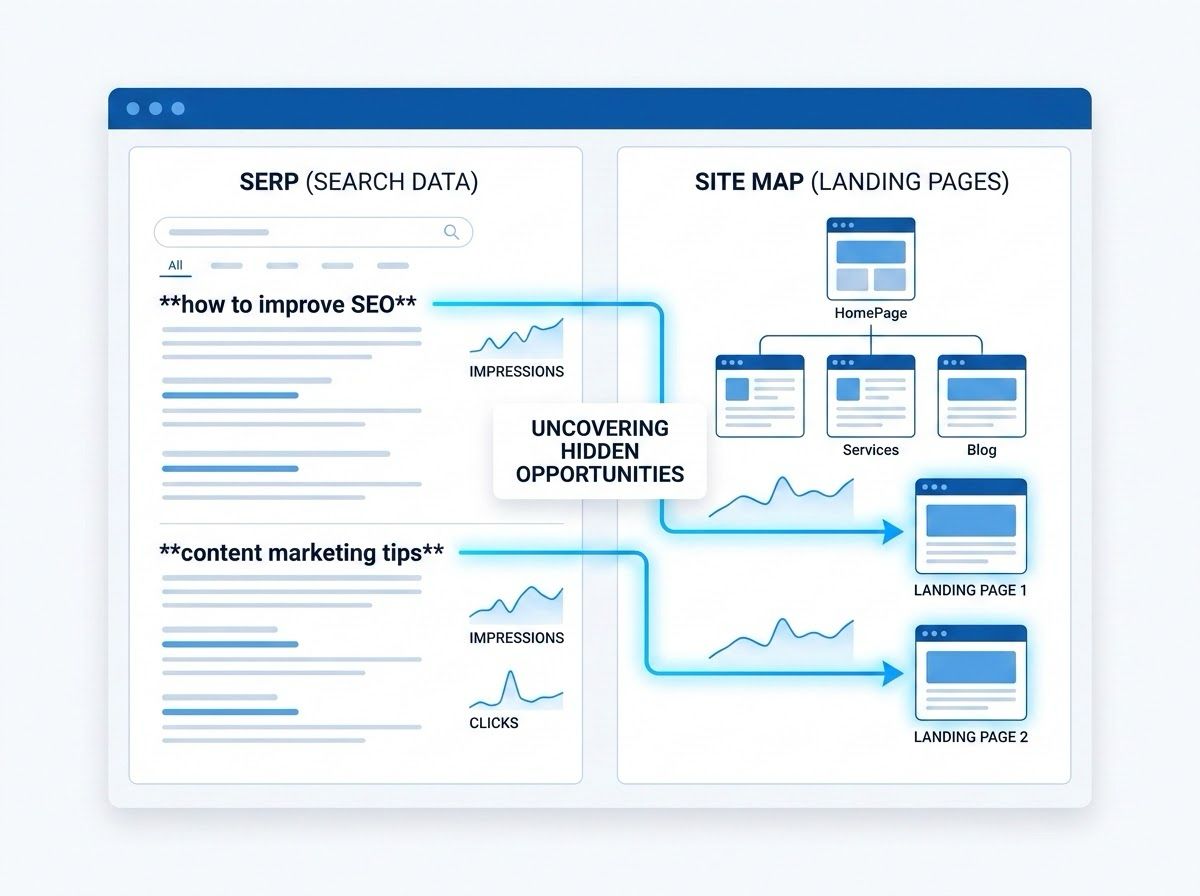
Begin with queries that bring impressions to your site. An impression indicates that a search engine has found some relationship between your page and the query-even if that query doesn’t get a lot of clicks.
Check out these queries page by page. A query might identify a question, use case, or issue that your existing content isn’t adequately addressing. It might suggest an absent part, a related article, or a new page based on different search intent.
Don’t treat everything as a new content idea for SEO. Check which page shows up for it, and whether the search naturally leads to it. If someone is already writing an article on the same thing, then adding another URL for it will just add a duplicate.
2. Groups of Related Queries
One search query can give you an idea. A cluster of related queries can disclose a larger subject.
Search demand can be fragmented over various questions, words, audiences and use cases. Seek questions that are similar in problem and/or intent. Content marketing services can categorise these queries to determine if they belong in a single useful resource.
Related questions about a group could lead to one larger guide instead of multiple small articles. Before making standalone pages, consider if each question needs a very different response.
Look for recurring patterns in:
- Problems
- Use cases
- Audiences
- Content formats
- Product categories
- Search intent
If the subject seems more appropriate to be part of an existing page, add content. Add supporting content if it requires additional depth. A separate page might be more appropriate if the search intent clearly differs.
3. Competitor Topics With Proven Search Demand
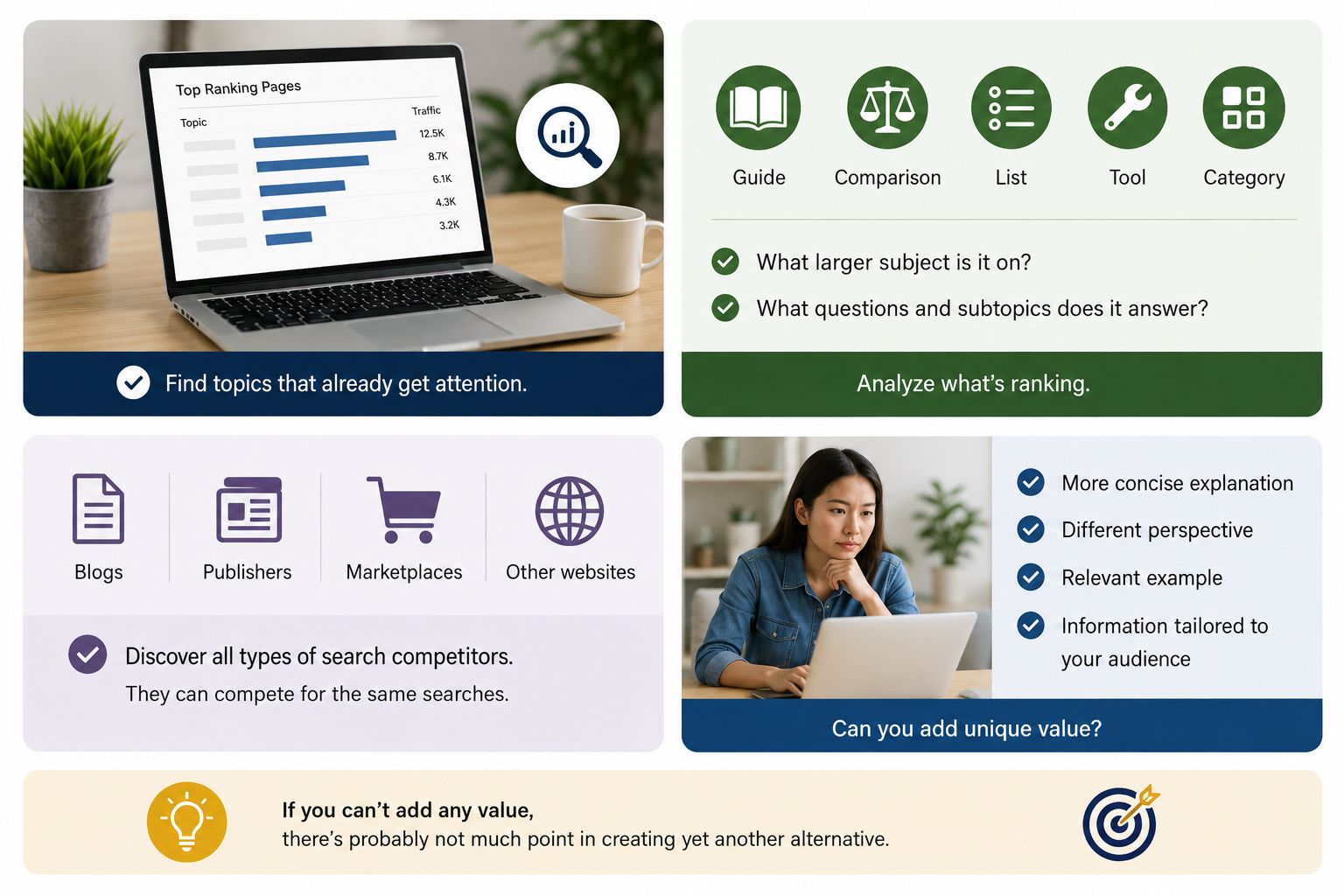 Competitor research can uncover themes that are already getting attention in your market. That does not necessarily mean copying what competitors are publishing. It means leveraging their search exposure to identify subjects worth evaluating.
Take a look at the pages that rank and think about what larger subject they are on. Determine if the page is a guide, comparison, list, tool, or category page. Then look at the questions and subtopics it is answering.
The SEO services will reveal search competitors who may not be direct business competitors. Blogs, publishers, marketplaces, and other websites can compete for the same searches.
The key question is: can your site provide anything useful? Think about a more concise explanation, a different perspective, an appropriate example or some information tailored to your target audience. If you can’t add any value, there’s probably not much point in creating yet another alternative.
4. Existing Pages With Room to Improve
There are already some potential opportunities to improve content on your website. Perhaps a particular page receives impressions but almost no clicks or shows up for a relevant search term without satisfying the query.
Examine the queries associated with weak-performing pages. Is it relevant to searchers’ queries? It might lack clarity, information, comprehensiveness, focus or structure.
|
Search Data Signal |
Content Opportunity | Action to Consider |
|
Relevant queries with impressions |
Missing information | Expand an existing page |
|
Related searches |
Broader topic |
Develop a targeted resource |
| Competitor visibility | Relevant topic gap |
Investigate a suitable angle |
|
An underperforming page |
Content may not meet the searcher’s needs |
Refresh the page |
|
A page with unrelated content |
Unclear topic focus |
Cut or separate the content into different pages |
Content marketing is not always about creating new content. Sometimes, an already existing URL is a good place for a topic. Take a look at the page before you decide if another article is necessary.
5. Opportunities That Point to a Clear Action
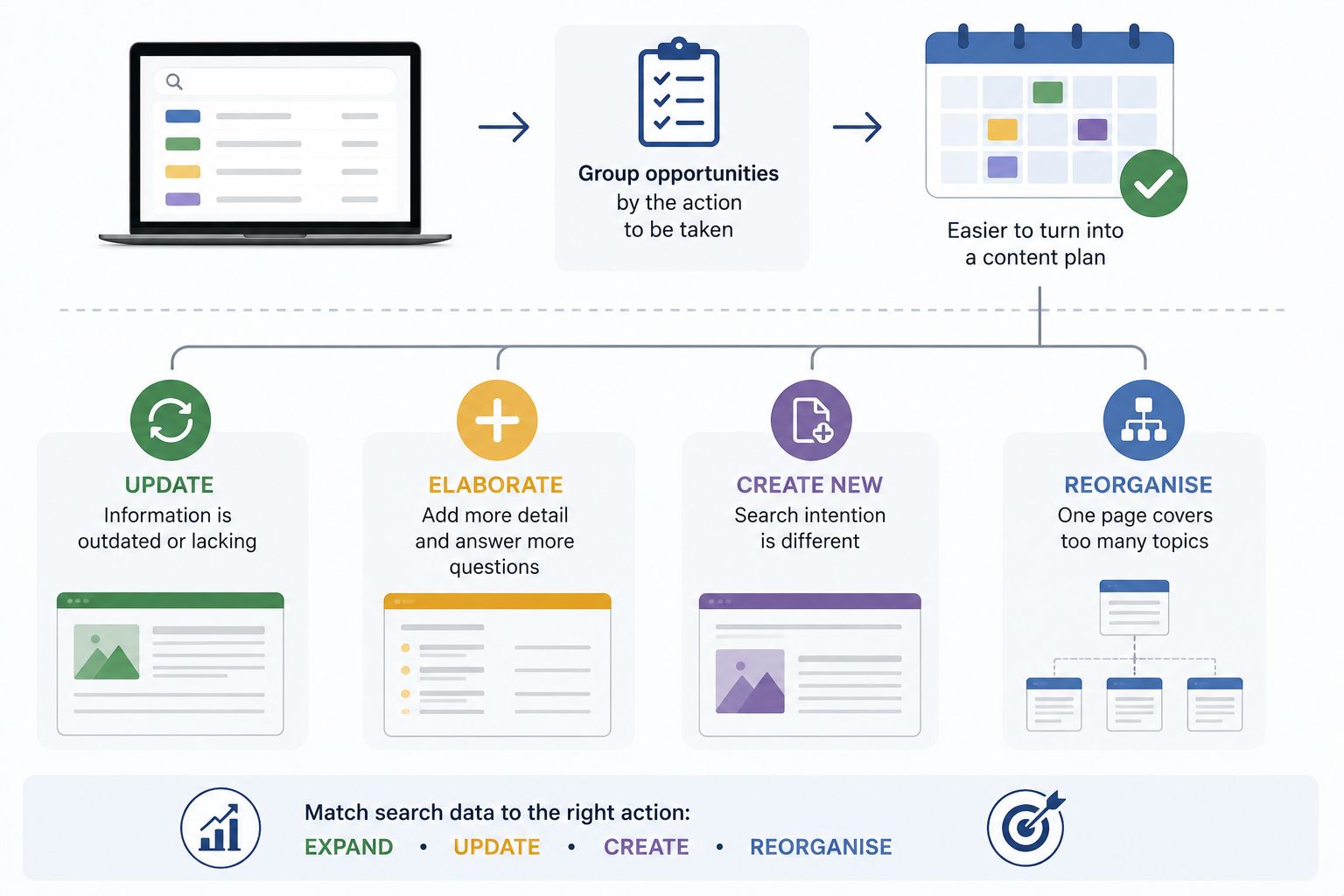 Just choosing an appropriate topic is not enough. You then have to determine what action should be taken.
Content marketing services can set out all the opportunities into categories based on the action that should be taken. This makes a huge list of keywords much easier to put into a content plan.
A page might need updating if the information is lacking. It might require elaborating if you have hit the main page but haven’t included enough questions. When the search intention is different, a new page is required. Sometimes reorganisation is necessary as one page is trying to accommodate too many different topics.
By tying search data to a particular action, SEO is more valuable. You might have a list of keywords that suggest to you that you need to expand, update, create or reorganise content.
How Should You Prioritise These Opportunities?
Prioritise. Not all opportunities can be tackled straight away. Assess each against search volume, relevancy, current ranking, competitiveness, potential business value and work required.
SEO services can use existing impressions as one useful signal when prioritising work. A niche topic where your site already has some presence may want more attention than a larger topic with higher competition.
Consider:
- The topic is relatively relevant to your audience.
- Or if they are actively searching for it.
- Your current visibility for related searches
- Sample what the current search results look like
- If the website is capable of 1 thing that is beneficial for you; then you should give it a try.
- How much work it takes to get the content.
Doing this makes it easier to differentiate between practical opportunities and keywords that just get good search traffic.
Use Search Data to Choose What to Create
Search data can reveal useful content opportunities. Look at existing queries that get impressions, groups of related queries, competitor content, and pages on your site that need improvement. The goal is not to create more content. It is to create what your site actually needs.
A clear content marketing plan starts with the search data you already have. Review each opportunity and decide whether it is relevant and worth working on. Prioritise them based on relevance and feasibility. Content marketing services can then create useful content instead of filling a calendar with unrelated topics.
